
Renault Clio Williams for sale
1 car in stock right now, inspected in the European country where it is located, priced landed at a US port with the import paperwork done.
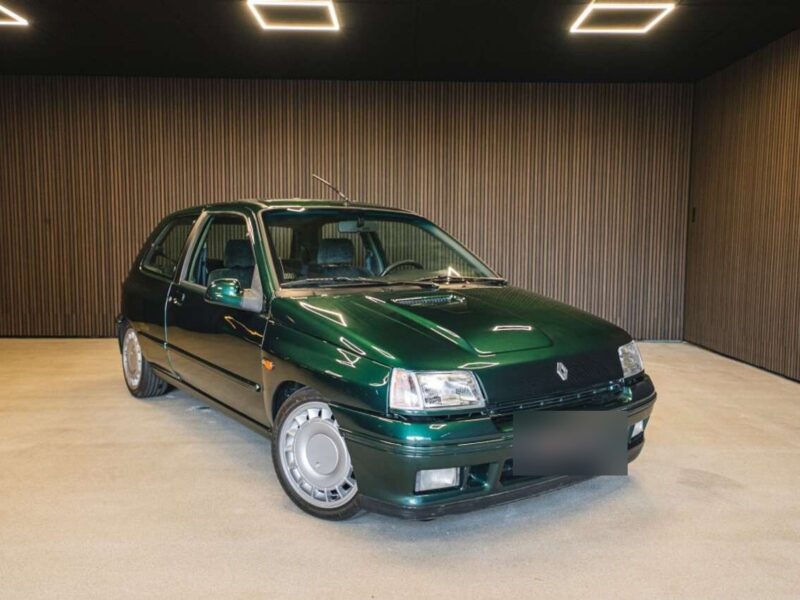
The Renault Clio Williams was shown at the Geneva motor show in March 1993 and sold from April 1993: a 2.0-litre of 147 hp (150 hp DIN) in a widened Clio shell, with a different suspension, 15-inch Speedlines and gold paint on a blue body. Renault had left the United States in 1987 and never sold it there.
Why Americans want it
It is the definitive 1990s French hot hatch, it is the car the Clio’s reputation rests on, and there has never been a legal way to buy one in America. It is also still affordable, which is unusual for a homologation special of this stature.
The three series
- Williams 1 (1993–1994), 5,417 cars. The initial run of 3,800 was extended by 1,600, and it is the only series with a numbered plaque.
- Williams 2 (1994–1995), 5,065 cars.
- Williams 3 (1995), 1,618 cars, export only, including 500 Swiss Champion.
About 12,100 in all. Production stopped in December 1995 on emissions grounds, and sales ended in early 1996 as stock ran out.
Eligible years (25-year rule)
Every Williams is eligible now. Production ended in 1995.
How to tell a real one from a conversion
This matters more here than on almost any other car on this site, because a Clio 16S converted to Williams appearance is cheap to make and the value gap is large. Three checks settle it:
- The date. A Williams cannot predate March 1993. A car registered in 1992 and offered as a Williams is a 16S, whatever the badges say.
- The power figure. The Williams is 147 hp CEE. The 16S is around 137 hp. A listing quoting 135 or 137 hp is describing a 16S.
- The numbered plaque, on Williams 1 cars, plus the Renault build documentation and the specific chassis and suspension parts.
A 16S built to Williams specification is a perfectly good car and we are happy to sell one — as a replica, at a replica price. We label ours that way.
What to look for
- Rust: rear arches, sills, the boot floor, the suspension mounting points and the scuttle.
- The F7R engine: shared with the Renault Sport Spider. Cam belt history and head gasket are the points to check.
- Originality: correct Speedline wheels, the gold paint, the interior. Many were modified or used on track.
- Accident history: these were cheap cars for a long time and were driven accordingly.
Typical landed price
Europe: roughly €15,000–€35,000 depending on series, mileage and documentation, with numbered Williams 1 cars at the top. Landed at Newark or Baltimore with duty at the rate in effect on entry: roughly $29,000–$60,000.
Registration notes
- California: built after 1967, gasoline; CARB lab certification applies, not guaranteed.
- Fuel: gasoline.
- Title: 17-character VIN. US title from Salvage Motors LLC; a US decoder will not return a Clio of this era.
Our take
Buy the plaque and the paperwork, or buy a conversion knowingly and pay conversion money. The one thing not to do is pay Williams money for a 16S.
FAQ
Was the Renault Clio Williams sold in the United States?
No. Renault withdrew from the US market in 1987, six years before the Williams was launched.
How many Clio Williams were built?
About 12,100 across three series: 5,417 Williams 1, 5,065 Williams 2 and 1,618 Williams 3.
How do I know a Clio Williams is genuine?
It cannot predate March 1993, it produces 147 hp rather than the 16S’s 137, and Williams 1 cars carry a numbered plaque. Renault build documentation confirms it.